With funding from Swim Across America – Boston, researchers at the Perini Family Survivors’ Center have developed innovative new protocols for treating long-term negative impacts of childhood cancer treatments, including sleep disorders, sexual dysfunction, and relationship challenges.
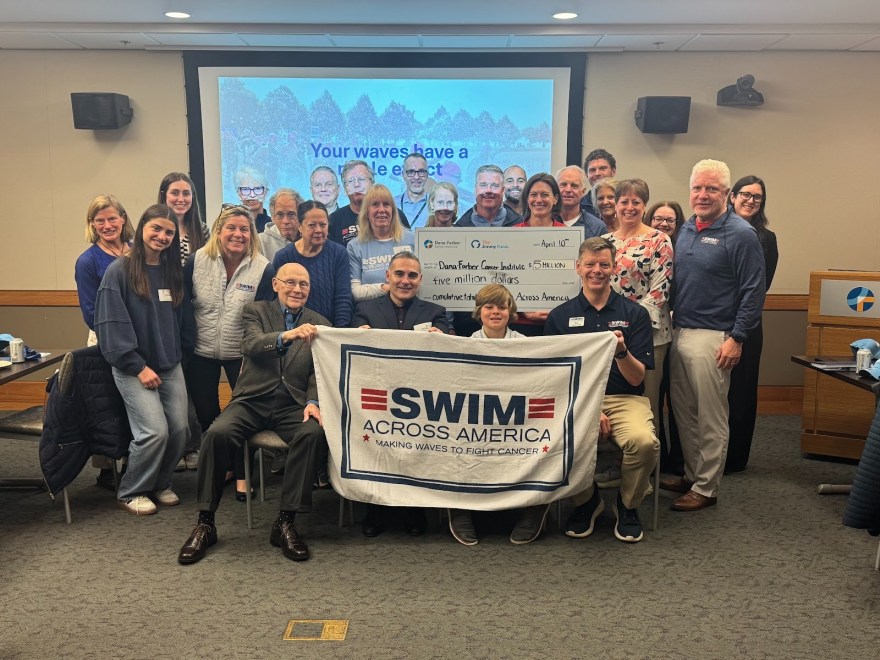
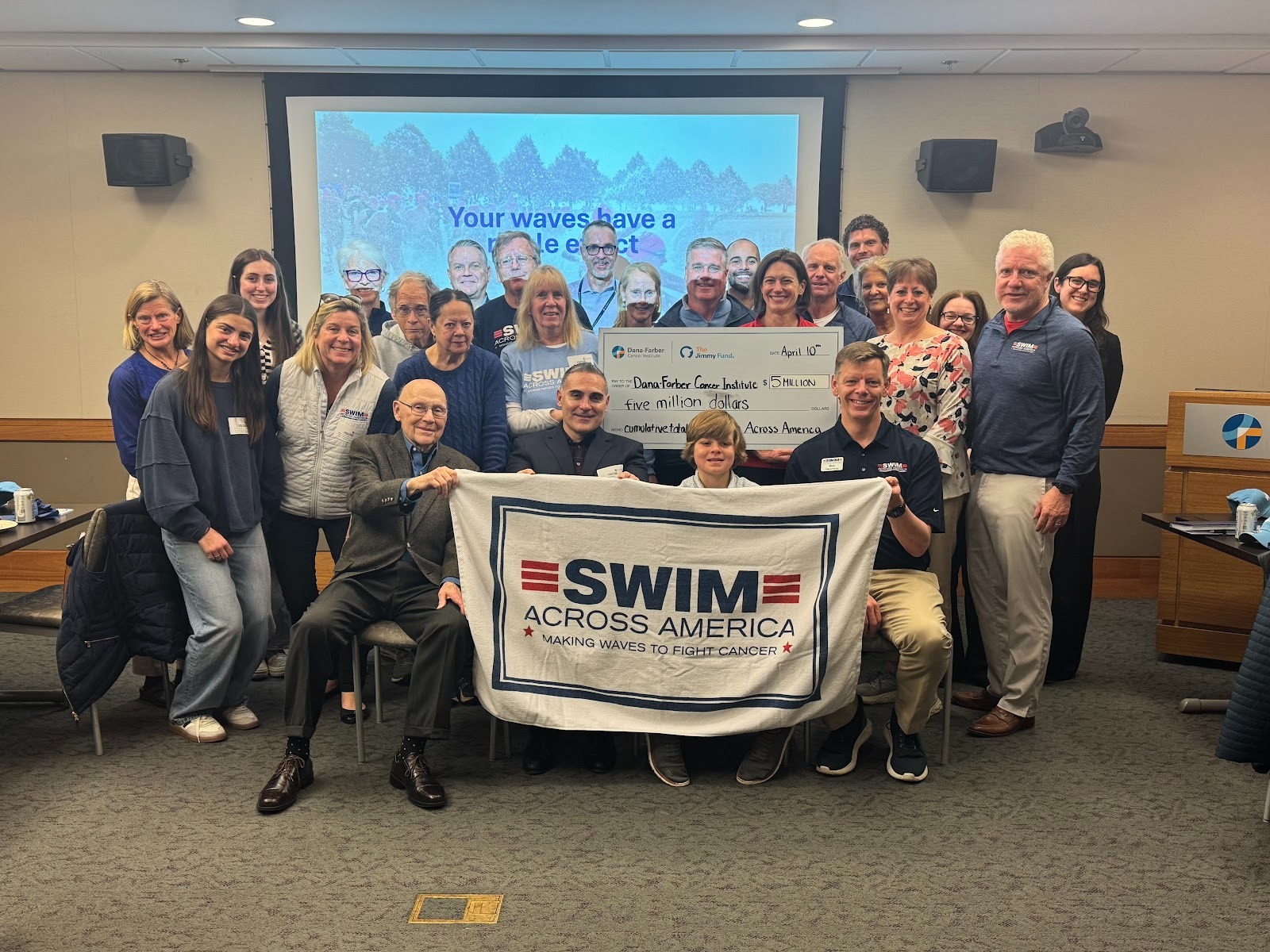
In April 2026, 30 Swim Across America – Boston (SAA-Boston) participants, volunteers, donors, and patients visited Dana-Farber Cancer Institute for presentations from five researchers, followed by a special tour of the Dana-Farber Cancer Institute (DFCI) facilities.
Researchers at the Perini Family Survivors’ Center use Swim Across America-Boston funds to test innovative new patient interventions and expand successful treatment protocols to culturally Latino communities
Director of Research Christopher Recklitis Ph.D., MPH, originally a Swim Across America Fellow at DFCI and who has swum the SAA-Boston event in Pleasure Bay, provided an overview of Project REACH, which encompasses a range of interdisciplinary, longitudinal studies targeting improved outcomes for survivors of childhood cancers. As more and more people survive childhood cancers, they form a growing population of patients who experience a wide variety of life-altering negative impacts of cancer treatment. Project REACH studies the unique cohort of DFCI
To date, Project REACH has published 21 peer-reviewed publications from 38 investigators and trainees, fulfilling two goals of expanding research while launching careers of the next generation of top research talent. As a result, at least 13 other major cancer institutions around the U.S. have investigators who were funded by Swim Across America at some point.
“SAA funding gives us the flexibility that no one else has to innovate when unexpected needs arise,” Dr. Recklitis explained. For example, in 2020, Project REACH used SAA funds to pilot a study of virtual treatment visits for survivors. The pilot began in April 2020, and they were able to publish the results in November of the same year. “Simply put, research never moves that quickly, primarily because funding requires more lead time. SAA funds enabled us to change course on a dime. Moreover, we were able to share our findings with practitioners around the world by publishing.”
Explaining her “Bridging the Gap” programs, Teresa Neira, PhD, LISCW explained the work she has been able to do to translate proven protocols to Spanish language and Latin cultural norms, making the benefits available to a significantly larger number of childhood cancer survivors. Dr. Neira explained that translating a treatment protocol is not simply about language, but also about cultural norms and points of reference. With cultural adaptations, Latino and Latina survivors are more open to and better able to access the benefits that are more readily available to English speaking Perini Center patients.
Director of the Perini Family Survivors’ Center Lisa Diller MD emphasized the flexibility that SAA-Boston funding enables. Since 2020, multiple SAA-funded researchers at DFCI have been able to secure large grants from the National Cancer Institute (NCI) by demonstrating promising results in a smaller Project REACH cohort. “These smaller test studies simply wouldn’t have been possible without the flexibility provided by SAA funds,” Dr. Diller said.
One such researcher, Lydia Chevalier, PhD, who also has swum the SAA-Boston event, opened by saying, “Swim Across America Fellowship completely changed the trajectory of my career.” In her fellowship, Dr. Chevalier found that, in her Project REACH respondent pool, 32% of the young adult cancer survivors (YACS) reported sexual dysfunction and 34% of YACS reported that they were sexually inactive. As one patient said to her, “How do you date when you’re scared to have sex?” SAA-Boston funding gave Dr. Chevalier the flexibility to shift her focus to deeply impactful work and secure a larger grant from the NCI.
Trainee Alexis Michaud (PhD candidate in Clinical Psychology) began working with Project REACH during the first year of her PhD program and developed one of her projects into her dissertation work. She is developing a Phase 2a proof of concept trial assessing the effectiveness of On-Trac, a brief online intervention to address anxiety to suit the particular needs of childhood cancer survivors, which are different from standard cognitive behavioral approaches. Michaud shared that the opportunity to do this level of research as a doctoral candidate was exceptional.
SAA-Boston visitors came away with a renewed sense of purpose and energy. As a twelve-year-old participant said, because of SAA-Boston funding, the Perini Center researchers “have seed money for the small ideas that turn programs into the standard of care at Dana-Farber, which other Cancer institutions mimic.” We are so proud to support this important work that benefits childhood cancer survivors.
To swim, volunteer, or donate to SAA Boston, visit the 2026 Open Water Swim site.


One thought on “Presentation and Tour for Swim Across America – Boston at Dana-Farber Cancer Institute”