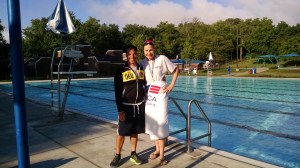
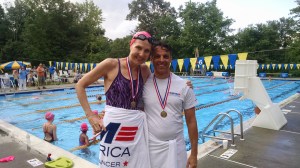
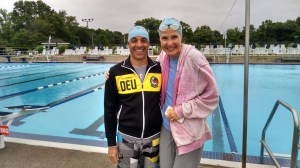
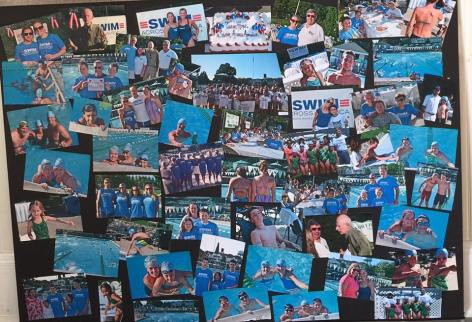
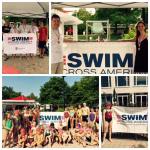
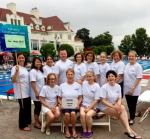
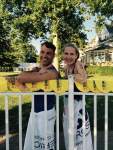
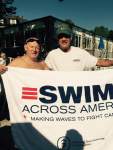
Swim Across America was excited to participate in the National Coalition of Associations of 7-Eleven Franchisees (NCASEF) Convention in Las Vegas. See if you can spot Olympic gold medalist Tyler Clary representing SAA at the golf tournament.
Day 2 of the NCASEF Convention in Las Vegas had the Swim Across America team and Olympic Gold Medalist Tyler Clary representing the great partnership that SAA has with the National Coalition of Associations of 7-Eleven Franchisees.
The convention concluded with a banquet that included a speech by SAA’s Rob Butcher on the impact of the partnership we have with NCASEF in the fight against cancer.
SAA Family Tree is a monthly focus on stories that display the impact all the members of the Swim Across America family have both locally and nationally. If you have a story or link you’d like to share, please send here.
Olympians Kristy Kowal and Heather Petri are mentioned in the same breath as Taylor Swift in this Boston Herald wrap-up.
SAA – Atlanta’s Event Director Megan Melgaard and Olympian Doug Gjertsenstopped by CBS46 to get everyone to Lake Lanier Islands on Sept. 17.
Brian Boyle writes #WhyISwim for the Huffington Post – look for Brian at SAA -Baltimore.
SAA – Atlanta’s Sheri Hart makes waves in Simply Buckhead magazine.
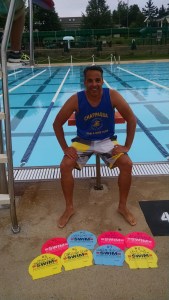
In Pool Swims Across America, we feature local pool swims that raise awareness for cancer research. If you’re interested in getting your local swim team or pool involved, learn more here.
July 10: Mudpuppies Swim Across America Memorial Event for Dr. Brian Goldman
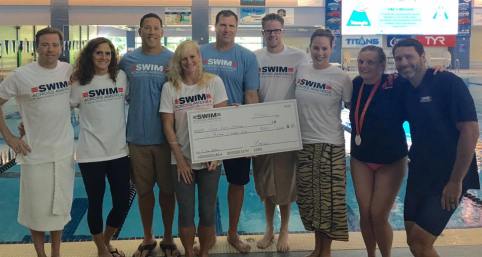
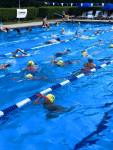
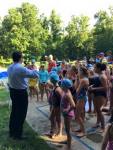
Thank you to our Olympians, National Team alums, Masters swimmers and host Mary DeMilia for the Mudpuppies pool clinic to Fight Cancer — it raised $6,600 in honor of Dr. Brian Goldman, who founded the Mudpuppies.
July 13: Heather Stark’s B’nai Mitzvah Cancer Defeat
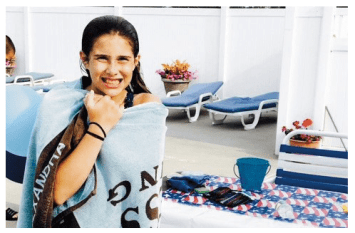
Shoutout to Heather for hosting a SAA pool swim as her B’nai Mitzvah project in Ivyland, PA – great job, Heather!
In 2016, Westchester Masters teammates Dan Levy and Carrie Dillon completed the mile swim at all eight of the Westchester and Rockland County pool events supporting Swim Across America – Long Island Sound. Levy is also a big part of the Chappaqua Swim & Tennis Club pool swim, where he’s been the swim coach since 1998.
Levy made all eight events in honor of his sister, Karen, who passed away after a long battle with colon cancer in 2008.
Dillon was able to swim in seven of the events with Levy, in honor her dear friend Joe Arena, who passed away in 2016 from brain cancer.
The duo also supports Ed Hickey, who continues his daily mile swims from July 11th to September 11th in memory of his son. Hickey has reached 64% of his goal. If you’d like to support his swims, you can still do so on his Swim Across America page.
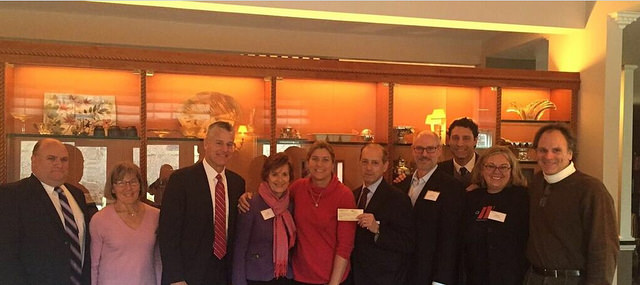
On July 1 Dr. Animesh Barua at SAA beneficiary Chicago Rush was notified that he has been awarded $1.7M in RO1 funding (the highest level) from the National Institute of Health. Swim Across America funding from the 2013 SAA Chicago swim enabled Dr. Barua to refine and bolster his study, which is the basis to developing a non-invasive early detection test for ovarian cancer. Currently, there are no early detection tests available for ovarian cancer – a very aggressive and hard-to-treat disease. If successful, Dr. Barua’s test could help the nearly 25,000 women in the United States who are diagnosed each year. Early detection is key. Roughly 14,000 women die annually of ovarian cancer. An effective, accurate test could drastically reduce that number. Critical seed money from Swim Across America was instrumental in allowing Dr. Barua to conduct his study which lead to the new funding from NIH.
(L to R: Dr. Animesh Barua; Dr. Robert DeCresce, Acting Chicago Rush Cancer Center Director; Faye Jacobs; Dr. Josh Jacobs, Associate Provost for Research Chicago Rush)
We are Swimmers, we are Friends, we are Families…We are TEAM HOPE.
TEAM HOPE in 2004 at North Hempstead CC
WE ARE SWIMMERS…
Mike Ford was your typical Swim Across America participant in 2000, when he swam with his daughter Keira in the Long Island Sound event as part of Team Doyle to support a family friend dealing with cancer.
After participating a few years in both the Long Island Sound and Sound to Cove swims, in 2004 Ford’s mission changed when three close friends were stricken with cancer. He was inspired to do more and created TEAM HOPE.
Nothing about Mike Ford’s Swim Across America story has been typical since then. Ford has kept the TEAM HOPE’s singular mission of fighting cancer focused and organized through the peaks and valleys over the last 13 years, and there have been plenty of both. TEAM HOPE has persevered to recruit and fundraise in larger numbers and will celebrate hitting the $1 million milestone as a team at the Sound to Cove benefit swim this week.
WE ARE FRIENDS…
The original core of TEAM HOPE members were North Hempstead Country Club members and staff, originally made up of 28 swimmers plus kayakers and volunteers. With North Hempstead as their unofficial home, they participated in the NCAC pool swim and the Sound to Cove open water swim and raised $30,000.
Over the years, some traditions have emerged that make TEAM HOPE special: the annual dedication board with its inspirational messages, the plaque that goes to the outstanding team member annually and of course, the large amounts of pasta that have evolved into club-wide barbecues.
In 2014, the ‘unofficial home’ of TEAM HOPE, North Hempstead Country Club, officially became the third swim to become a part of the family. Now TEAM HOPE participates in three swims annually and is fundraising more than ever.
As TEAM HOPE has grown, Ford has been inspired by the hundreds of swimmers, the generosity of thousands of donors and the countless hours given by the volunteers.
Ford is quick to point out TEAM HOPE wouldn’t be where it is today without the dedication of Laureen Keenan. He credits Keenan for assisting him tirelessly over the years, helping him stay organized with all volunteers and ultimately taking TEAM HOPE to greater heights.
(l-r) Marty Bergin, Laureen Keenan, Dr. Marc Symons, Mike Ford
WE ARE FAMILY…
TEAM HOPE emphasizes family participation. This year, of the 92 team swimmers, 59 are participating with another family member. Ford is particularly proud of the year that three generations of swimmers from one family swam together. TEAM HOPE is family.
In fall 2005, Ford was sadly struck by a cruel irony when his wife Patti was diagnosed with cancer. The fight against cancer became very personal. Over the ensuing decade, Ford continued pushing TEAM HOPE forward as Patti faced her own struggle against cancer until her heartbreaking passing this year. The $1 million milestone is more than just a number for Mike, his daughter Keira and TEAM HOPE.
TEAM HOPE in 2016
WE ARE TEAM HOPE…
As can be imagined, the $1 million fundraising milestone hasn’t been accomplished without many poignant moments. Ford continues to swim with TEAM HOPE and has adopted the custom of inscribing his swim cap with those he swims for.
Despite the bittersweet start to the year, there are signs that HOPE springs eternal. The timing of the $1 million milestone serendipitously occurs during North Hempstead Country Club’s centennial celebration. The breakthroughs in immunotherapy at Memorial Sloan Kettering (a TEAM HOPE beneficiary) are making national news. It’s easy to see how Ford easily finds inspiration by those that have surrounded TEAM HOPE:
His friend that courageously battled cancer and returned to swim with TEAM HOPE and regards the annual swim as his “most important day of the summer”
Father Rich Henning, the “Paddling Padre” that penned the TEAM HOPE Prayer and kayaked for a number of years
The 8-year-old that asked in lieu of gifts and presents for his birthday and his First Communion, that donations be made to TEAM HOPE and raised over $850 that year
The lifeguard that participated in two NHCC pool swims and was proud to tell Ford she has an internship in Oncology as she finishes her nursing school degree
As TEAM HOPE gets to over 90 members this year and hits the million dollar mark, we appreciate and recognize the commitment to the cause by Mike Ford and his incredible team. There are a million reasons to believe that this is only the beginning.
If you are moved to help Mike Ford and TEAM HOPE reach $1 million raised this year, you can contribute here.
The Long Island Sound Pool Swims are a huge part of the success of SAA – Long Island Sound! We want to give thanks and recognition to the hundreds of swimmers, volunteers and donors that make all these incredible benefit pool swims happen. Get all the Swim Across America news on the Sound as it hits at the SAA – LIS Facebook page.
Sarah Cohen participated for the first time and in her own words:
I swam for my first time this year with SAA in the Lake Isle pool swim. I swam to support my mom who was diagnosed in April with metastatic melanoma. My partner, best friend and I made this video for her, and all the people who donated, of the swim … SAA has brought me some relief- a place to put my energy and focus. A way to channel all the chaos that cancer causes in a family members life- and funnel it into something good and honorable. My mom was in the hospital most of the summer, including the day of the swim- but she is home now- still battling. I hope this video can bring strength and hope.
If you are more of a video tutorial person, check out what Sterling Ralph (Jr. Board member of SAA -Atlanta) created to make the process simple to follow.
SAA Family Tree is a monthly focus on stories that display the impact all the members of the Swim Across America family have both locally and nationally. If you have a story or link you’d like to share, please send here.
The Tampa Open Water benefit swim and relationship with the Central Florida 7-Eleven Franchise Owners Association was featured in the national FOA magazine.
Your donations allow SAA to provide funding to some of the world’s most renowned cancer institutions. This is the third in a series featuring the SAA LABS that our beneficiaries have named in honor of the efforts of Swim Across America.
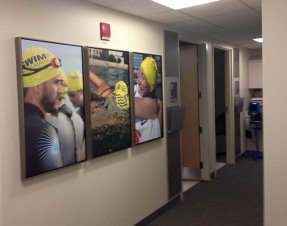
This month, we are profiling the Swim Across America Laboratory for Cancer Research at Rush University Medical Center. This lab, and a Patient Procedure Suite, were named for SAA in 2015 after more than $1 million was raised by SAA since 2011.
Each year, Rush University Medical Center runs an internal, peer-reviewed process to distribute the funds from SAA – Chicago. Rush researchers submitted more than 20 proposals for consideration for the proceeds from last year’s Chicago events, which included the open water swim at Ohio Street Beach and the 2nd Swim Across Lake Michigan. Four research projects will be funded from 2015 and the awards have been made to support projects focused on a variety of treatment disciplines that impact patients with breast, colon, liver, and lung cancers, among others.
Kevin Gray, Director of Development at Rush University Medical Center was kind enough to answer some of our questions.
Can you shed some light on the cancer research being done in the SAA lab??
The cancer research being done with SAA funds varies from breast, gastro, lung and other. Dr. Jeff Borgia’s lab, which was named the Swim Across America Laboratory for Cancer Research, focuses on two areas: 1) Identifying a genetic marker within specific proteins that determine a person’s likelihood that they have or could develop lung cancer. And 2) fine-tuning a blood test – finger prick – that could be used in all primary care offices, but specifically in underserved communities and areas with high incidence of lung disease.
Dr. Borgia leading a team of SAA staff, swimmers and committee members on a tour of the SAA Laboratory for Cancer Research
What kind of grants have been acquired through the research?
There have been more than two dozen grants from various sources that continue to help all investigators during the timeframe of the SAA relationship. Most notable, two investigators, Drs. Carl Maki and Amanda Marzo, have leveraged SAA dollars to garner NIH funding. Dr. Marzo received $425,000 earlier this month and Dr. Maki received $375,000 last year.
What exciting plans does Rush have for 2016 and beyond?
The most exciting plans are technology and equipment investment. A computer-based initiative called bioinformatics and a biorepository will take Rush to the next level in terms of productivity and competitiveness. Bioinformatics is the ability, through extremely fast computers, to process an enormous amount of data in an extremely short time. Information that used to take weeks now can be processed in days or hours. It will be paired with the biorepository, which is housed in the SAA lab, which can process and store large amounts of tissue or blood samples for study. This enables the investigators to work faster and more efficiently, revealing new answers and results that potentially lead to a treatment or cure.
What does the lab mean to Rush?
It means a myriad of things: 1) It enables Rush to conduct meaningful research with an almost instant impact on patients. 2) It attracts the best and the brightest to Rush as the institution is tackling cutting-edge work. 3) It makes Rush a stronger academic institution as tomorrow’s doctors, nurses and other medical professionals get to work side-by-side with the best And 4) It puts Rush and those with SAA backing in a position to find the best solutions for new treatments and possibly a cure.