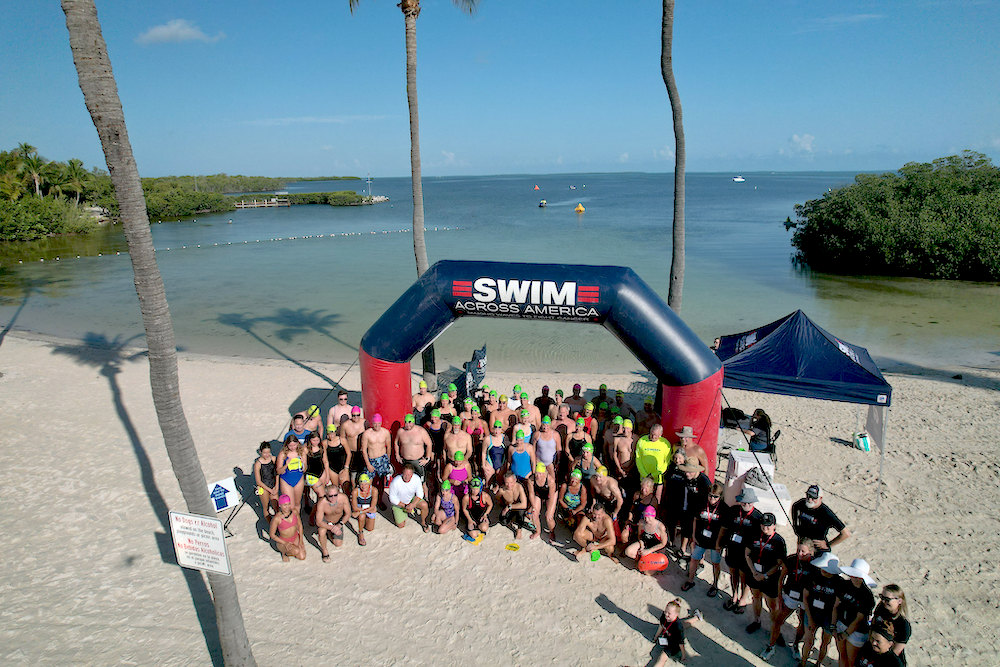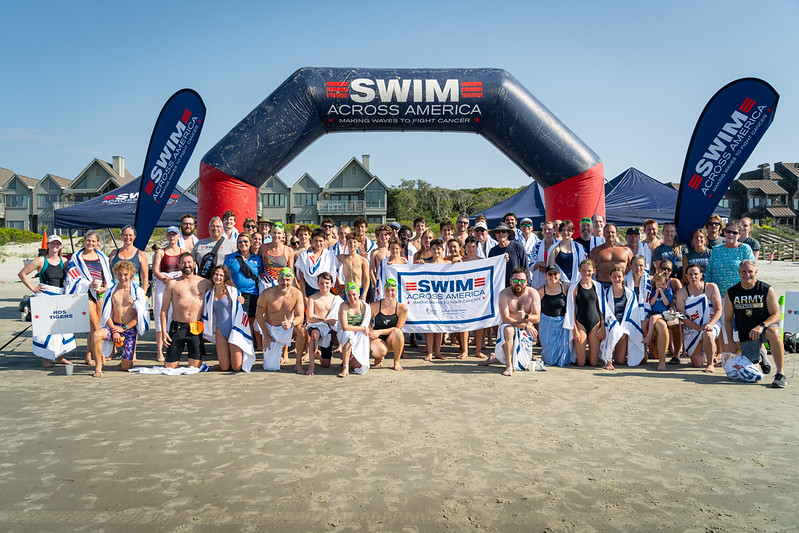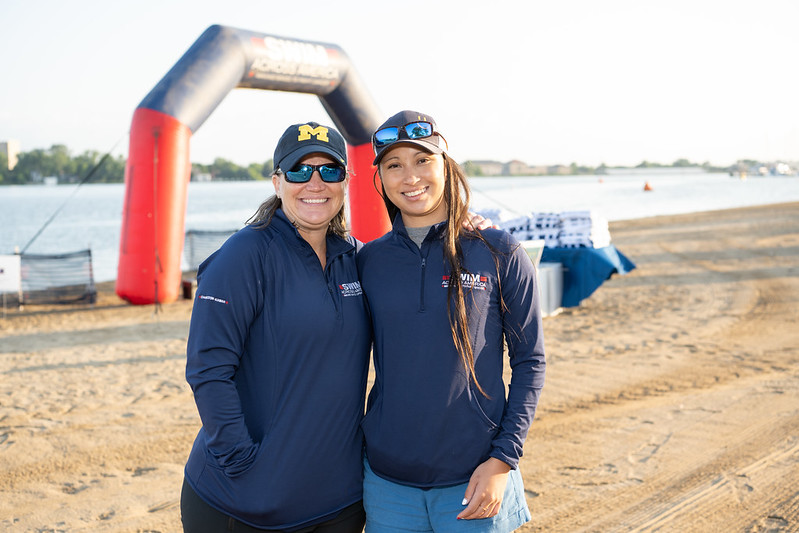
Most Swim Across America participants wear their SAA swag with a sense of pride of making an impact in their community. For Natalie Thompson and her family in Nantucket, Massachusetts, it’s more than just an event — it’s a way of life.
“Swim Across America – Nantucket gear is a badge of honor on this island. We swim for the people we see everyday — our neighbors, our friends, and our family — so we can make their fight easier,” said Natalie.
Natalie Thompson, her wife Cassie, and their two sons at a Swim Across America – Nantucket event.
Swim Across America – Nantucket gives grants to on-island cancer treatment and care at Nantucket Cottage Hospital and Palliative and Supportive Care of Nantucket. It also supports glioblastoma research at Mass General Cancer Center in Boston. The unique offering of on-island care allows patients fighting the toughest battle to remain close to home while receiving outstanding treatment.
When it comes to SAA gear, Natalie and her family have plenty. Since 2012, she has participated in the event — in every and any capacity — alongside her wife, Cassie, and their two sons.
“I’ve been part of the setup crew, the breakdown crew, an angel swimmer, a 4-miler… whatever I can do, I do,” said Natalie. “My wife has always volunteered, and now she runs the Falmouth Road Race to support our swim. SAA is just part of our lives. We do it as a team to support our amazing community.”
Natalie first joined SAA-Nantucket to honor her grandmother, who fought breast cancer. As the years went by and Natalie remained involved, cancer would hit close to home not once, but twice more.
“June 2019 changed why I swim for the rest of my life. My wife was diagnosed with ocular melanoma at 33. We had two young boys at the time, and suddenly, we were facing cancer head-on,” she shared.
Natalie swims the 4-mile course while her wife, Cassie, kayaks beside her.
“Eight hours after she was diagnosed we attended a Swim Across America event and I knew we had a support system like no other. No one at the event knew that night of her diagnosis but I left having hope that we would make it through it all. This was the first summer I participated in the 4 mile swim and it was even more impactful having my wife as my kayaker.”
Less than a year later, Natalie’s family was hit with more devastating news.
“In March 2020, our world was rocked again. My dad was diagnosed with stage 4 renal cancer,” Natalie said.
“As soon as I heard the news, Jill Roethke and Jim Pignato, SAA-Nantucket co-event directors, were my first call. The world was shutting down due to COVID, and my dad needed tests to begin treatment. They got me connected to the right people, and in that moment, I knew our family had endless support from our Swim Across America family.”
For as long as SAA-Nantucket is around, Natalie and her family will be there, supporting the mission and their community — a value she’s proud to pass on to her sons.
Natalie and her boys love to match in SAA gear!
“SAA’s impact on the Nantucket community as a whole means that no one fights their cancer battle alone. We are a community on a little island ensuring that cancer patients spend their invaluable time with their families and friends instead of countless hours traveling for treatment elsewhere.”
“My kids have grown up attending the event, and it’s incredible to teach them about this special support system. They know I swim for their grampie and mom. It’s a special moment every year when I finish the 4-mile swim to have my kids see me finish.”
If you’re inspired to support Natalie and Team Thompson, give here.
When Sarah Wiseman was diagnosed with breast cancer in June 2022, it came as a complete shock. Though her mother had been diagnosed with the same cancer in her 60s, Sarah’s genetic marker testing had come back negative. It was a routine mammogram that led to her breast cancer diagnosis.
“I had a routine mammogram that was concerning, which led to further diagnostic testing—an ultrasound and a biopsy,” Sarah explained.
“I had a seed inserted via biopsy, then underwent a partial mastectomy/lumpectomy and lymph node removal during surgery. One lymph node tested positive for metastasis. After healing from surgery, I received radiation treatment on my lymph nodes and left breast — 20 treatments in total. I’m grateful to have had access to a tumor test that evaluated the effectiveness of chemotherapy on my specific tumor. The results came back below the threshold for needing chemo!”
Sarah Wiseman, a member of the SAA-Nashville committee, was declared in remission from breast cancer in 2023.
This year, Sarah celebrates her remission and looks forward to swimming in the 4th Annual Swim Across America – Nashville. Funds raised from the event support Vanderbilt-Ingram Cancer Center (VICC), where Sarah received treatment.
Sarah swam as a child but really fell into the sport watching her children swim on club teams and in college. Once she got the all-clear from her doctors, Sarah knew exactly how to get her strength back while doing something she loved.
“After I healed from my surgeries, I couldn’t wait to swim. I joined the local Masters team, and thanks to my friend Chris McPherson, I was introduced to Swim Across America,” said Sarah.
Chris McPherson, along with Alyssa Corb and Laurin Bobo, is a co-event director for SAA-Nashville.
“This community event is a wonderful way for me to give back to the doctors, nurses, and caregivers who took such great care of me during treatment,” Sarah said.
Swim Across America’s guiding principle is that money raised locally stays local — something that resonated deeply with Sarah. She takes great pride in supporting an organization that directly benefits her community, especially given her firsthand experience with how much cancer treatment has evolved.
Members of the SAA-Nashville committee and researchers from Vanderbilt-Ingram Cancer Center present the fundraising total at the 2024 SAA-Nashville community pool swim.
“In the past, having a positive lymph node would have meant automatic chemotherapy. Today, I am closely monitored by my medical oncologist and surgical oncologist at Vanderbilt Breast Center. And I’m proud to be raising funds for others in our community—people who will be treated at VICC, just like I was,” said Sarah. “I am a beneficiary of the incredible advances in cancer treatment. My mother didn’t have access to these options during her fight. She really struggled, and I believe newer-generation treatments made my journey much easier.”
Now in remission, Sarah is grateful that Swim Across America allows her to support two of her greatest passions: swimming and the cancer care team at VICC.
“I just feel incredibly blessed to have received the life-saving treatment I did,” Sarah shared. “Swimming has had the best impact on my health, and since my cancer diagnosis, I’ve embraced a much healthier lifestyle. I love that SAA allows me to give back through two of my favorite things: swimming and Vanderbilt-Ingram Cancer Center.”
If you’re inspired to support Sarah and team Wisemans Wack Cancer, give here.
For 15 years, Swim Across America has fueled innovative early-stage research at Fred Hutch Cancer Center and UW Medicine and helped launch the careers of dozens of young scientists. We’re proud to share details about the six most recent projects made possible through funds raised in 2022 and 2023 by Swim Across America – Seattle and the dedicated swimmers who participated. From improving patients’ quality of life to overcoming tumors’ resistance to immunotherapy, these innovative projects have the potential to dramatically enhance cancer treatment.
Inspired to Make Waves to Fight Cancer this year? Swim, volunteer or donate to SAA-Seattle at swimacrossamerica.org/seattle.
Kate Markey, MBBS, PhD, FRACP | Stem cell transplantation
Assistant Professor, Fred Hutch and UW Medicine
Project: Restoring the gut microbiome after blood stem cell transplant
Dr. Kate Markey
Background: Fred Hutch researchers have shown that while blood stem cell transplantation continues to be the most effective treatment for multiple myeloma, it can also severely damage patients’ gut microbiome, leading to strong gastrointestinal side effects and poor outcomes. Dr. Markey, a medical oncologist who studies the gut microbiome and its role in recovery from transplant, developed a study to examine whether a five-week, plant based, whole-food diet can restore patients’ beneficial gut bacteria and improve immune function and outcomes.
2024 progress statement: Dr. Markey and her colleagues opened the trial in October, and by the end of the following month they had enrolled seven patients, or one-third of their goal. They are collecting stool and blood samples and plan to analyze all of them once the trial is complete. If all goes as expected this summer they intend to use the resulting data to apply for a federal research grant to support a much larger, randomized clinical trial.
Alexandre Hirayama, MD | Blood cancers
Assistant Professor, Fred Hutch and UW Medicine
Project: Understanding how large B-cell lymphoma evades CAR T-cell therapy
Dr. Alexandre Hirayama
Background: Less than half of patients who undergo CAR T-cell therapy for large B-cell lymphoma (LBCL) enjoy long-lasting remission. We’re not sure why, but the answer may lie in the tumor microenvironment. There’s still so much we don’t know about this collection of cells, stroma, and blood vessels that surround and support the tumor, including how it might suppress cancer therapies. Dr. Hirayama, who specializes in treating patients with B-cell malignancies, is studying the tumor microenvironment in minute detail to help identify and explain how patients’ tumors may mute CAR T cells’ effectiveness.
2024 progress statement: Dr. Hirayama has gathered the necessary tumor samples for these studies and refined the techniques and technologies that will allow him to study immune, stromal, and tumor cells in the tumor microenvironment. He expects to begin studying the samples in summer 2025.
Diane Tseng, MD, PhD | Lung cancer
Assistant Professor, Fred Hutch and UW Medicine
Project: Reducing inflammatory effects of immunotherapy in patients with lung cancer
Dr. Diane Tseng
Background: Many patients with lung cancer who are treated with checkpoint inhibitors experience a condition called checkpoint inhibitor pneumonitis (CIP). If left untreated, CIP can cause irreversible damage. Recent research shows that immune cells called napsin A–specific T cells may be involved in mediating CIP. Dr. Tseng, an oncologist who specializes in treating patients with lung cancer, is working with McGarry Houghton, MD — a Fred Hutch and UW Medicine professor and holder of the Satya and Rao Remala Family Endowed Chair — to study napsin A–specific T cells’ role in CIP and exploring strategies for muting it.
2024 progress statement: Dr. Tseng’s work has focused on 1) developing a method for detecting napsin A– specific T cells in donor blood; 2) developing a method for taking those cells and growing more of them in the lab; and 3) creating a test to determine whether a different T cell can eliminate them. This work will establish the foundations for understanding the function of napsin A–specific T cells and the role they might play in CIP.
Emily Liang, MD | Blood cancers
Hematology/oncology Fellow, Fred Hutch and UW Medicine
Project: Mitigating serious side effects of CAR T-cell therapies in patients with blood cancers
Dr. Emily Liang
Background: While CAR T-cell therapy has revolutionized treatment for patients with blood cancers like lymphoma and multiple myeloma, it also comes with a high risk of fever, fatigue, body aches, and even neurologic impairment. Though these conditions are reversible, they can be life-threatening and prevent older and frailer patients from receiving CAR T-cell therapy at all. Dr. Liang, who specializes in acute leukemias and CAR T-cell therapy, and her mentor, Jordan Gauthier, MD, MSC, a Fred Hutch and UW professor and former Swim Across America funding recipient, want to make these treatments accessible to a wider range of patients. So, the pair launched a first of-its-kind trial to study whether a drug typically prescribed for rheumatoid arthritis called anakinra can prevent these inflammatory responses.
2024 progress statement: After treating more than 30 patients in their clinical trial, Drs. Liang and Gauthier found that prophylactic administration of anakinra did not seem to be effective in preventing cytokine release syndrome, a side effect associated with a high level of inflammation in the blood. However, prophylactic anakinra did seem to reduce the severity and duration of neurologic side effects as well as the need for steroids. Importantly, Drs. Liang and Gauthier also found that anakinra may impair the treatment’s effectiveness against tumors. Now, the pair are planning to study how anakinra mitigates inflammation in the brain, whether there may be alternative prevention strategies, and how anakinra impacts CAR T-cell function.
Saurav Kumar, PhD | Colorectal cancer
Postdoctoral Fellow, Fred Hutch
Project: Exploring new uses for existing drugs to treat colorectal cancer
Dr. Saurav Kumar
Background: Colorectal cancer is one of several cancers driven by a process called gene fusion, in which two independent genes combine incorrectly and begin producing proteins that can lead to cancer. And though a range of drugs have been developed to target these fusions and stop the mechanism that promotes cancer growth, they’ve so far been ineffective against colorectal cancer. However, Dr. Kumar, who studies metastasis, recently discovered that patients with colon cancer who receive TRK inhibitors (TRKi) experience a drop in TRK fusion protein levels, suggesting that these inhibitors may be degrading the cancer-causing fusion proteins. He plans to study the interaction that causes this protein degradation with the goal of one day using TRKi to create more effective therapies for patients with this form of cancer.
2024 progress update: Dr. Kumar and his colleagues have developed three protein degraders, called PROTACs, based on an FDA-approved TRKi. Now they plan to begin testing them on colorectal cancer cells in the lab to better understand the mechanism that leads to TRK fusion protein degradation — which could one day inform the development of targeted therapies for patients with these cancers.
Yapeng Su, PhD | Pancreatic cancer
Postdoctoral Fellow, Fred Hutch
Project: Overcoming solid tumors’ resistance to immunotherapies
Dr. Yapeng Su
Background: Pancreatic cancer is notoriously difficult to treat. Though we’ve found a protein on tumor cells that would seemingly make for a good immunotherapy target, treatments that have been studied and validated in the lab fail in patients — likely due to unique characteristics of the tumor microenvironment. Using technology that allows us to see the interaction of cells within tumors and better understand how they influence one another, Dr. Su, who studies adoptive cellular immunotherapy, is examining the mechanisms that cause immunotherapies to fail and exploring techniques to overcome them.
2024 progress statement: After completing a detailed study of samples from tumors previously treated with adoptive T cell therapy, Dr. Su found that they contained several cell types that were both potentially immunosuppressive and arranged in distinct patterns throughout the tumor microenvironment. He also identified several subtypes of T cells (whose role is to attack cancer cells) that no longer functioned properly. In the coming months, Dr. Su plans to further analyze the T-cell subtypes and their placement within the tumor microenvironment to better understand why they stop working. What he finds could one day help us better engineer T cells to overcome those immunosuppressive forces.
Swim Across America (SAA) is pleased to announce the winners of the 2024 SAA College Cup. More than 45 collegiate, club, and alumni teams and over 1,400 participants all united to make waves in the fight against cancer through swimming and friendly competition.
Swim Across America awarded the top fundraising team, the top collegiate fundraiser, and a bonus team chosen at random.
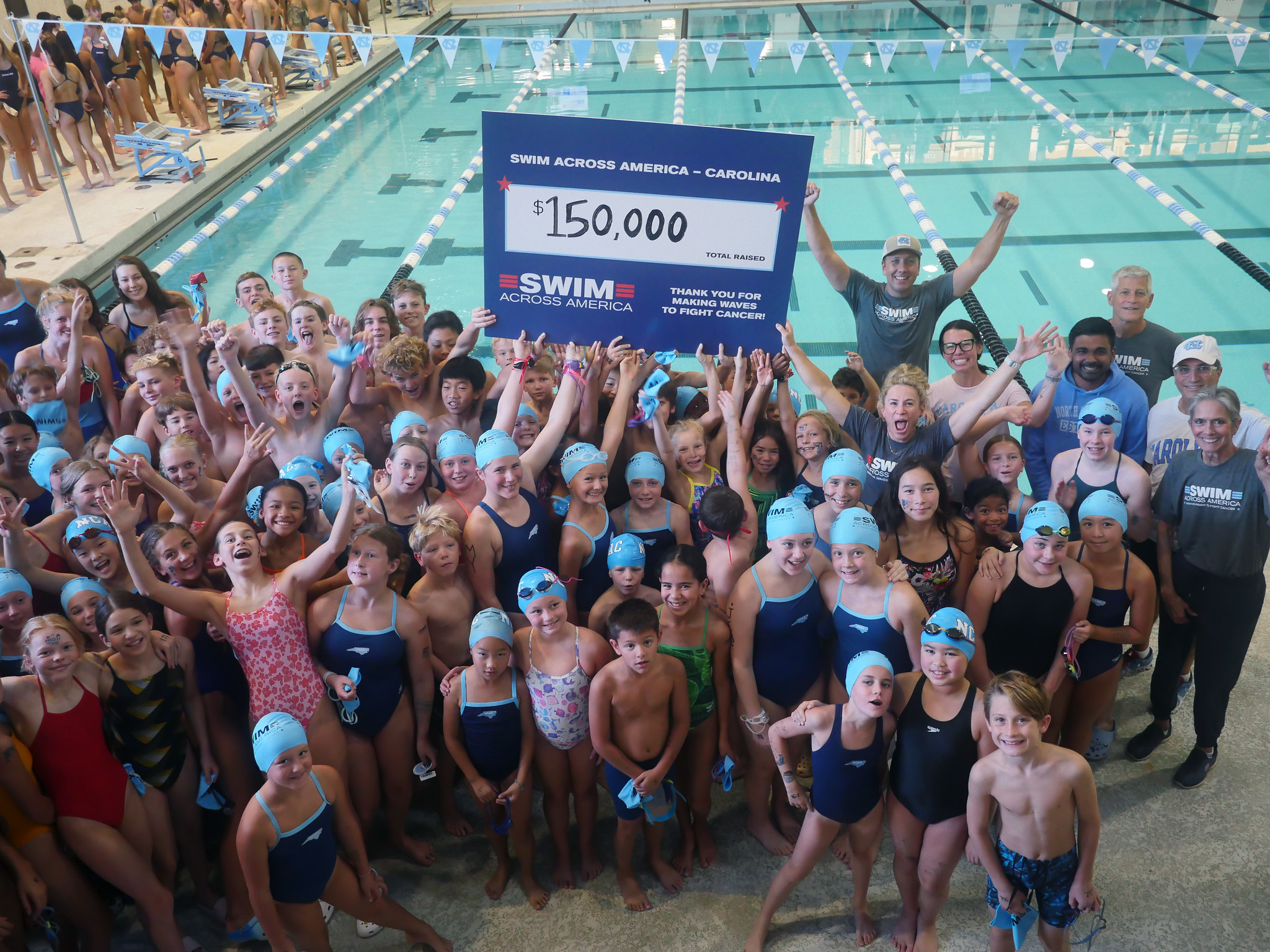
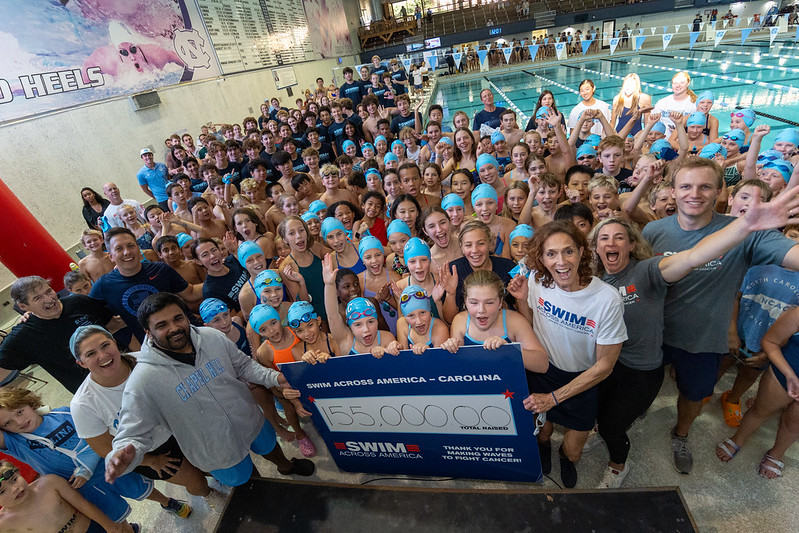
Congrats to the top fundraising team, Team Tar Heel! The top team is led by co-captains, Georgia Nel and Sue Walsh, and raised more than $96,000. Funds raised by Team Tar Heel supported the Swim Across America – Carolina community.
Team Tar Heel from the SAA-Carolina community is the winner of the Swim Across America College Cup. Congrats!
For Olympian and University of North Carolina at Chapel Hill alum, Sue Walsh, Swim Across America’s mission is deeply personal.
“My involvement became even more personal when I heard the words myself, ‘You have metastatic colon cancer.’ As someone who spent most of her life committed to the sport of swimming, it made perfect sense to partner with SAA in the fight against cancer, including my own.”
Congrats to the top collegiate fundraiser, Alyssa Corb, who raised over $24,000! Alyssa is a student at the University of Tennessee, Swim Across America – Nashville co-event director, and long-time supporter of Swim Across America – Baltimore. Over the years, Alyssa and her family have raised more than $200,000.
Alyssa Corb and her mother, Jennifer, at the 2024 SAA-Nashville community swim.
“My main inspiration for swimming is my brother Michael, who passed away from mixed lineage leukemia when he was nine months old,” shared Alyssa.
“I was 2 when he was born and 3 when he was diagnosed and died. I don’t remember every second but I do remember loving every minute with him, and his face lighting up whenever I walked into his room. To me, Swim Across America is not just about raising money to find a cure, it’s to honor and remember those who fought their battle and prevent other parents, siblings, and families from going through the loss of a loved one.”
SAA also recognized a collegiate team chosen through a random drawing: Providence College Swimming and Diving team from Providence Rhode Island. The team of more than 100 swimmers raised more than $64,000 and were awarded a Vasa Trainer Pro. Funds raised by the team from Providence College Swimming and Diving supported Swim Across America – Rhode Island.
The Swim Across America College Cup was announced in 2023 and invited college teams, athletes, and alumni to join the organization’s mission of funding cancer research, clinical trials, and patient care programs through community charity swims. Teams participated by registering for one of Swim Across America’s open water charity swims, joining or starting a pool swim, or participating virtually through the SAA My Way program. Participants affiliated with a U.S-based college or university were eligible to compete in the College Cup. Teams consisted of current college students, alumni, or a mix of both, and could be small as one person.
The Swim Across America College Cup was supported through partnerships with CSCAA, Vasa, and GoSwim.
About Swim Across America
Swim Across America, Inc. (SAA) is dedicated to raising money and awareness for cancer research, prevention, and treatment through swimming-related events. With the help of hundreds of volunteers nationwide and past and current Olympians, Swim Across America is helping find a cure for cancer through athleticism, community outreach and direct service. To learn more visit swimacrossamerica.org or follow on Facebook @SwimAcrossAmerica or on Instagram @SAASwim.
About CSCAA
Founded in 1922, the CSCAA is the nation’s first professional coaching association for intercollegiate athletics. The CSCAA boasts more than 2,000 member coaches and assistant coaches, recognizes All-American swimmers and divers, NCAA record-breakers and Scholar All-America athletes and teams, as well as outstanding coaches and contributors, and helps oversee the welfare of collegiate swimming and diving. Learn more about CSCAA at cscaa.org.
About Vasa
Vasa empowers swimmers, surfers, and triathletes to become stronger, better, faster in sports, fitness, and injury rehab. Vasa offers specific equipment such as swim ergometers, trainers, sport benches and other accessories to provide athletes with safe, effective training methods. Founded by Rob Sleamaker, an acclaimed exercise physiologist and author, who has worked with Olympians, biathletes, and triathletes as well as some of the world’s most respected swim coaches to reinvent their training practices. Learn more about Vasa at vasatrainer.com.
About GoSwim
GoSwim creates content that helps people of all ages and backgrounds to swim better and reach their full potential in the sport. GoSwim’s videos are acclaimed and unsurpassed for clarity of filming and clarity of content and commentary. GoSwim was founded in 2002 by Olympian Glenn Mills and business colleague Barbara Hummel. Learn more at goswim.tv.
Read or watch local stories featuring the Swim Across America-Charlotte community to learn about their impact. Learn more about the event and beneficiary, Levine Cancer Institute and Levine Children’s Hospital, at swimacrossamerica.org/charlotte.
In August 2024, Charlotte resident, Julia Brookshire, completed the Hellespont-Dardanelles swim through a partnership between Swim Across America and SwimTrek Swimming Holidays. She also celebrated retirement, a serendipitous new career, and being in deep remission from Chronic Lymphocytic Leukemia. Find media highlights from Julia’s adventure here.
Read or watch local stories featuring the Swim Across America-San Francisco community to learn about their impact. Learn more about the event and beneficiary, UCSF Benioff Children’s Hospitals (Oakland and San Francisco), at swimacrossamerica.org/sanfrancisco.
Swim Across America – San Francisco participant, Maya Merhige, successfully completed the English Channel swim in July 2024. Maya is a top fundraiser for SAA-SF, a member of the Junior Advisory Board, and a high school junior in the Bay Area. To read media highlights from Maya’s historic swims, click here.
Read or watch local stories featuring the Swim Across America-Nassau/Suffolk community to learn about their impact. Learn more about the event and beneficiaries at swimacrossamerica.org/ns.
This summer, George Sushkoff and his family took a special vacation to Southern California. Why was it so special?
“Our vacation was originally scheduled for last summer, but we had to postpone it because I was in treatment for colon cancer,” said George. “I’m thankful to be in good health this summer and able to share these wonderful memories with my family.”
In April 2023, George was diagnosed with Stage 1 to Stage 2 colon cancer. George had participated in Swim Across America – Richmond since 2019, and was familiar with the organization and its mission. After his diagnosis, he knew exactly who to turn to for support.
“One of my close friends contacted Rob Butcher, CEO of Swim Across America, and told him my story. By lunchtime that day, I had received a call from Rob to discuss my diagnosis and next steps. By dinnertime the following day, I received a call from a nurse liaison at VCU Massey Cancer Center, who said they wanted to help,” shared George.
“The amount of support I received from my swimming community and from Swim Across America was unbelievable.”
George Sushkoff joins Swim Across America – Richmond as a swimmer and survivor this year.
George met with doctors at Virginia Cancer Institute (VCI) and VCU Massey to discuss treatment options. Though he received treatment at VCI, he felt that both centers were collaborating on his care.
“It was comforting to know I had the support of both VCI and VCU Massey. They weren’t fighting over who got to treat me – though they should have,” George jokes. “They were focused on my health and well-being, and me coming out of this a survivor.”
George Sushkoff, center, at the 2023 SAA-Richmond community swim.
On December 1, 2023, George received his final chemo treatment and on December 23, he had an exam with his surgeon. Scar tissue had formed where the tumor was and George couldn’t have been happier.
“Where the tumor was. The tumor was completely gone! This is considered a full clinical response. I’m not gonna lie, it was an emotional day,” said George.
From that day on, George’s journey is full of joyous and celebratory milestones.
January 8, 2024: George met all the criteria for being considered in remission.
March 25, 2024: The portacath used for chemotherapy treatments was removed.
April 30, 2024: Stopped taking Eliquis, a blood thinner, and the final medication George was prescribed.
May 11, 2024: George competed in the Downriver Rip, a 4.4 mile swim in the James River.
May 26, 2024: George competed in the Reston Lake Swim 1-mile and 2-mile events, placing first in his age group in each event.
June 16, 2024: George competed in the Virginia Beach Lifeguard Association 1-mile swim, placing first in his age group.
June 22, 2024: George participated in the Ocean View Mermaid Festival 2-mile open water swim.
“I was first in my age group for the Mermaid Festival swim, but to be transparent, they did not issue awards. Maybe next year.” joked George.
August 25, 2024: Next up, George will swim in the 6th annual Swim Across America – Richmond community swim at Quest Swimming in Midlothian, Virginia. The community has raised over $320,000 to support their beneficiary, VCU Massey Comprehensive Cancer Center since 2019.
Since 2021, George and his team, Team River City, have raised $90,000 and have a goal of raising $30,000 this year.
“Looking back on everything I’ve been through this past year, I’m feeling great. I am completely off medications and survived this awful disease. This year’s SAA-Richmond swim will be even more special in my eyes,” said George.
If you are moved to support George and Team River City, you can donatehere.
Read or watch local stories featuring the Swim Across America-Long Island Sound community to learn about their impact. Learn more about the event and beneficiaries, Memorial Sloan Kettering Cancer Center, Columbia University Cancer Center, Cancer Support Team and Weill Cornell Medical Center, at swimacrossamerica.org/long_island.
Read or watch local stories featuring the Swim Across America-Nantucket community to learn about their impact. Learn more about the event and beneficiaries, Nantucket Cottage Hospital, Palliative and Supportive Care of Nantucket, and Mass General Cancer Center, at swimacrossamerica.org/nantucket.